
Why do Amish women wear head coverings? Amish women (and many Mennonite women) wear prayer coverings because they believe the Bible teaches women to cover their heads when praying, as described in 1 Corinthians 11. They also see the covering as a symbol of submission and obedience to God.
I grew up Amish and wore a prayer covering until I was in my thirties. In this article, I'll explain why Amish women cover their hair, the difference between prayer coverings and bonnets, and what I came to believe about this practice.

Jump to:
- Why Do Amish Women Wear Prayer Coverings?
- Is the Amish Prayer Covering Biblical?
- Why Do Amish Women Wear Head Coverings All the Time?
- Prayer Coverings or Bonnets?
- Different Types of Amish Hair Coverings
- Differences Between Amish and Mennonite Head Coverings
- History of Women's Head Covering
- Should Women Cover Their Heads?
- My Experience with the Head Covering
- More About Amish Life and Traditions
Why Do Amish Women Wear Prayer Coverings?
Amish women wear prayer coverings for several reasons, based on their understanding of 1 Corinthians 11:
- Obedience to Scripture: They believe the Bible commands women to cover their heads when praying. Since they should always be ready to pray, they wear their coverings all the time.
- A symbol of submission: The covering represents a woman's submission to her husband, or to her father if she is unmarried.
- Spiritual protection: Some Amish believe that wearing a covering provides special protection because of the reference to angels in 1 Corinthians 11:10.
These beliefs are also taught in many Mennonite churches, although practices and interpretations vary between groups.
Is the Amish Prayer Covering Biblical?
Growing up in the Amish church, I was taught that wearing a head covering is a Scriptural command. 1 Corinthians 11 has several verses that address this issue:
Verse 4. Every man praying or prophesying, having his head covered, dishonoureth his head. 5. But every woman that prayeth or prophesieth with her head uncovered dishonoureth her head: for that is even all one as if she were shaven. 6. For if the woman is not covered, let her also be shorn: but if it is a shame for a woman to be shorn or shaven, let her be covered. 7. For a man indeed ought not to cover his head, forasmuch as he is the image and glory of God: but the woman is the glory of the man.
Verse 10. For this cause ought the woman to have power on her head because of the angels.
Verse 13. Judge in yourselves: is it comely that a woman prays unto God uncovered? 14. Doth not even nature itself teach you, that if a man has long hair, it is a shame unto him? 15. But if a woman has long hair, it is a glory to her: for her hair is given her for a covering. 16. But if any man seems to be contentious, we have no such custom, neither the churches of God.
I left out a few verses from this passage that you can find in your Bible. But these are the verses in the Bible that address the head covering.
Why Do Amish Women Wear Head Coverings All the Time?
The Amish people try to obey every command in the Bible and they take them literally. Although, I will say that there are some commands in the Bible that they completely overlook because they are not included in their traditions.
But this Scripture passage in Corinthians is why they believe that every woman must have her head covered to pray. You may ask, "Why does she have to wear a head covering all the time and not only when she's praying?" Their answer would be that a person must always be ready to pray.
So then you may ask, "Why do Amish men wear hats then if they are supposed to be uncovered to pray? Should they not also be ready to pray at any moment?" This is one example where their rules are not consistent. Because technically, a man should never wear a hat if they want to be consistent in following this Scripture.
But the Amish people are often more concerned with keeping the ordnung and traditions than they are in actually figuring out what God wants them to do. There are many things that they do simply because that's how they have always done it.
Prayer Coverings or Bonnets?
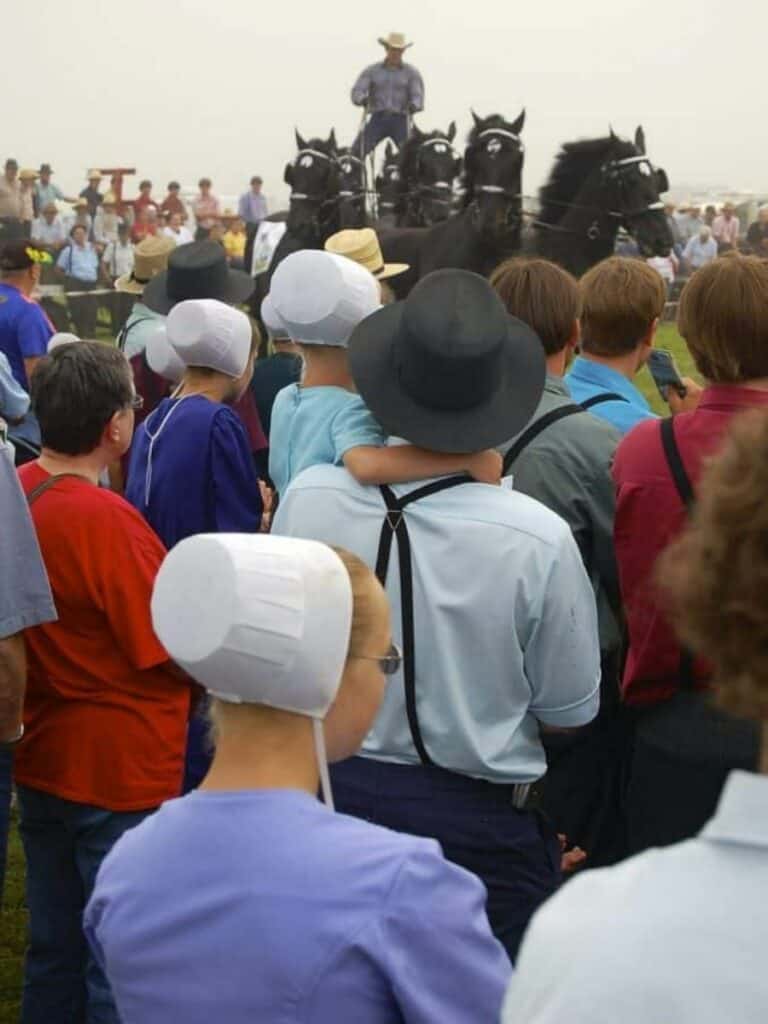
Many people call the Amish prayer covering a bonnet, but they're actually two different things. The prayer covering (Kapp) is the head covering that's pinned onto the woman's hair. Amish women wear this all day long, taking it off only to wash and comb their hair. (Remember they must always be ready to pray.)
Many of them wear something on their head at night as well. Some may wear an old covering that they don't care if it gets smushed and wrinkly, but we used to wear a big handkerchief or a veil made out of fabric.
The bonnet, however, is usually black and is worn as an outer covering. In our church, it was worn only in the wintertime to help keep our heads warm. But some of the stricter Amish women have to wear it anytime they leave home.
Different Types of Amish Hair Coverings
Amish women wear different styles and sizes of prayer coverings, depending on their church and community. Each Amish group has its own rules about the style of covering women are expected to wear. Sometimes you can even tell which Amish group a woman belongs to by the shape and size of her covering.
Many Amish women wear a straight-sided, box-style prayer covering, although the size and shape vary. Some are quite large, covering most of the hair and even the ears.
The Lancaster County Amish have a distinctive heart-shaped or butterfly-style prayer covering that's quite different from the styles worn in many other Amish communities. I grew up wearing this style, and I hated it.
I'm not sure why the Lancaster Amish adopted this particular style, but it's one of the things that makes their traditional dress easy to recognize.
I'm leaving a link here where you can find photos of the numerous different styles of head coverings that Amish women wear.

Differences Between Amish and Mennonite Head Coverings
There are many different styles of Amish and Mennonite head coverings, and they vary greatly from one church and community to another.
Generally speaking, Amish women tend to wear larger prayer coverings than Mennonite women. Some Amish coverings are quite large, covering most of the hair and the ears. Mennonite coverings, on the other hand, range from styles that are almost as large as Amish coverings to tiny, doily-like coverings that sit on the back of the head. Some Mennonite women also wear cloth veils instead of the traditional prayer covering, while others don't wear a head covering at all.
In Lancaster County, the difference between Amish and Mennonite coverings is often more noticeable. In other communities, their coverings may look quite similar, with the main difference being their size.
With so many different styles, sometimes it's hard to tell whether a woman is Amish or Mennonite simply by looking at her head covering (especially if you haven't grown up in that culture).
History of Women's Head Covering
Even though I grew up Amish, I never really studied the history of the Amish prayer covering, and I don't know exactly when this practice began. But I found an article on this subject which I found to be interesting, and I'm leaving a link here in case you are interested in reading it.
A head covering or hat for women seems to have been a cultural thing in numerous countries for many years.
The Amish and Mennonites originate from the Anabaptist movement in Europe that began in the 16th century. So wearing a head covering was probably a part of the culture that they originated from.
Should Women Cover Their Heads?
The women's head covering is one of the most important doctrines in the Amish and Mennonite churches. And I was taught very strictly that a woman MUST have her head covered to pray. I honestly felt like God would not hear me if I did not have my head covered. And I thought that I might go to hell if I didn't wear a covering.
We knew that other Christian women in the world did not wear head coverings. So the question arose, "Will they go to heaven?" The answer to that question was, "They can probably get to heaven without it because they were not taught like we were." But for us to not cover our heads would be a sin, since we know better.
But, in answer to the question, "Should women wear a head covering?" I will never say that it's wrong for a woman to wear a prayer veil. If you feel convicted by God to wear a covering, go ahead and wear one. But I have concluded that making a doctrine and law out of this issue is wrong. And if you believe that wearing a head covering is a salvation issue and will help you get to heaven, you are very wrong.
I don't claim to know exactly what Paul was trying to say in this passage to the Corinthians, but I honestly believe that it was a cultural issue.
My Experience with the Head Covering
As I've stated, I was taught very strictly on this issue of the prayer covering. It was ingrained into my very being that this is something I MUST do. But after listening to one pastor, I concluded that the head covering needs to be worn, with my head covered completely, only while praying or prophesying in a public assembly. And the church we attended at the time started practicing it like this.
But after we completely left the Mennonite church, and I was the only woman in church wearing a head covering, I began questioning this passage very deeply. I went to church with some very Godly women who didn't cover their heads. And it hounded me daily, "What does God want me to do?? Why is this passage of Scripture in the Bible, and what does it mean?"
I battled over this Scripture for many weeks and couldn't seem to come to a conclusion as to what this Scripture was saying. Is long hair considered to be our covering? Is Scripture saying that we should wear a covering over our long hair? Or was Paul addressing a cultural issue that doesn't necessarily apply to us today?
I kept seeking God about the issue and finally came to a place where I felt like He was telling me to let it go. I felt like it wasn't a big deal to God, whether I covered my head or not. He kept bringing the verse to my mind, "Come unto Me, all you who labor and are heavy laden, and I will give you rest." And I found so much freedom and rest in Christ when I quit trusting in works to make me holy.
More About Amish Life and Traditions
If you enjoyed this article about the prayer covering, perhaps you would like to read more info about the Amish...
- Difference Between the Amish and Mennonites
- Do the Amish Pay Taxes?
- Amish Wedding Customs and Traditions
- A Day in the Life of an Amish Woman
- Growing Up on an Amish Farm as an Amish Child
- Amish Food - Traditional Amish recipes
- Why Don't Amish Men Have Mustaches?
Having grown up Amish and wearing a prayer covering for so many years, I understand how important this practice is in Amish and Mennonite communities. Although my beliefs about head coverings have changed, I hope this article has helped you better understand why Amish women wear them and what they represent.
If you have questions about Amish head coverings or would like to share your thoughts, feel free to leave a comment below. I always enjoy hearing from my readers.
AMAZON DISCLOSURE: I am a participant in the Amazon Services LLC Associates Program, an affiliate advertising program designed to provide a means for me to earn fees by linking to Amazon.com and affiliated sites. If you click on a link to make a purchase, I may earn a small commission at no extra cost to you. Thank you.
Doctrines of the Bible - by Daniel Kauffman includes a discussion on the women's head covering along with other Doctrines that the Amish and Mennonites teach.

Stephanie Cote
I am apostolic which we follow quite the same biblical principles. Probably why so many Apostolic Pentecostal people also appreciate the Amish and Mennonite Communities. We always were taught that uncut hair is a covering, although some mexican apostolics would still wear head coverings.
Chris
Uncut hair is a natural kind of covering, but Paul distinguishes between the natural and the man-made covering by using two different Greek words. He is not saying the hair is the same as the veil covering, he is saying the two go together, a natural covering provided by God through nature, and a veil to cover that while praying and prophesying to show the order of headship in public worship. Paul makes very careful arguments and they need to be followed in the order he made them, not using any small part in isolation to try and overturn another part. It is important to read and study the passage from beginning to end, not to look for reasons to ignore any part of it.
Mette Karlsen
I love wearing my kapp. I was raised as an Atheist, which I hated, and am so grateful I made my way to Anabaptism. I would never say anything critical about women or girls not wearing a kapp, but I do feel all should, because it says so in the New Testsment. I feel happiest, most confident, safest, and most respected with my kapp on.
Jenna
Me too!
Dawn
Thank you for sharing! I’ve often wondered what part of the beliefs has to change to leave this practice and you’re the first one to explain. I’m one of the ones who have wrestled through those same questions you described and have decided to still wear it for prayer. But along with that my view has changed about it being a salvation issue. I also know many godly sincere Christian woman who don’t wear head coverings and I do not pass a judgement on them. I love them as Christian sisters.
Melissa
Hello Dawn and thank you from the bottom of my heart. I am a Christian and attend a Non-denominational church. As 1 Corinthians says, our hair is our covering. But, at times, I feel called to put either a shoulder wrap, shawl, or large handkerchief on my head when praying. I don't know if that is from God or not but, I do it. Especially when I have my hair pulled into a ponytail. I sometimes put one on when I have it in a ponytail and it is hot. It also keeps my hair from falling in my face when I am cleaning, cooking, or baking. I admire the Amish and Mennonite communities for their sense of community, being hardworking people, the simplicity of their lifestyle, and the fact that Amish and Mennonite people are very self sufficient in canning and butchering their food, being bee keepers and just the way they live. I know many Englishers who live the same way.
I am a God-fearing, saved Christian who does her best to not judge others about anything. We are to love everyone, not just those who are close to us. Just because someone is different, lives differently, or belongs to a different church doesn't give us the right to judge them for their beliefs. It is our job to love them, pray for them, and do our best to live godly lives to show ungodly people what they are missing out on. We are to share our faith with others, it is what God wants us to do.